
QIE Machinery
QIE Machinery
QIE Machinery
QIE Machinery

Ghana presents a compelling and timely opportunity for establishing a palm oil processing mill, driven by a structural supply deficit where domestic production meets only 70% of national demand, resulting in nearly $200 million in annual imports. Historically rooted in Ghanaian culture, the palm oil industry is undergoing rapid modernization as the government aggressively promotes local manufacturing to curb expensive imports and satisfy skyrocketing industrial demand from the cosmetics, food, and biofuel sectors.
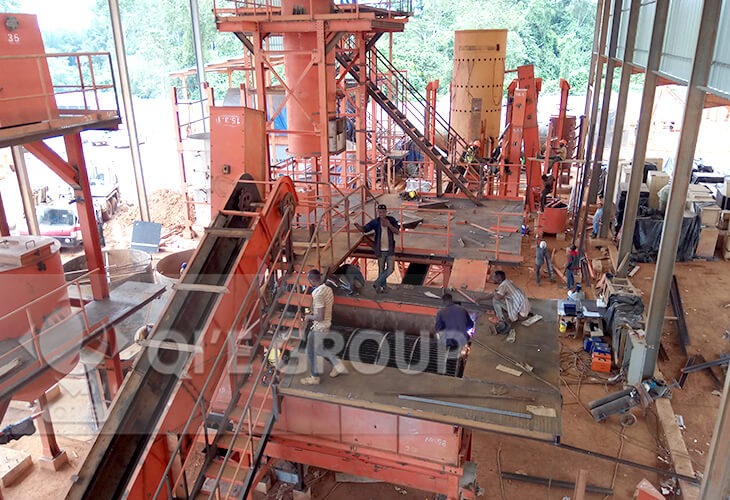
The palm oil processing industry in Ghana is entering a highly lucrative “Red Gold” era, driven by major government investments, a push for import substitution, and a rapid shift toward advanced, climate-smart milling technologies. Historically reliant on inefficient, small-scale artisanal centers, Ghana is actively modernizing its value chain. This makes processing mills one of the country’s most compelling agribusiness investment opportunities.
| Oil Type / Feedstock Source | Est. Annual Local Production | Primary Market Segment & Production Dynamics | Strategic National Outlook (Targeted Impact) |
|---|---|---|---|
| Palm Oil (Tree Fruit) | 50,000 MT | The primary edible oil consumed nationwide. Heavily dominated by low-yield artisanal smallholder mills. | Target to eliminate a 200,000 MT national supply deficit via modern mill technologies. |
| Palm Kernel Oil (PKO) (Seed) | 85,000–95,000 MT | Main industrial seed oil. Highly demanded by domestic FMCG manufacturers for cosmetics and soaps. | Upgrading crushing equipment to boost local high-purity oil fractions and restrict raw nut exports. |
| Groundnut (Peanut) Oil (Seed) | 15,000–25,000 MT | Heavily integrated into traditional northern cooking and domestic food processing. | Subsidizing pest-resistant seed varieties to stabilize rural production cycles. |
| Soybean Oil (Seed) | 5,000–10,000 MT | Fast-growing sector driven directly by the government’s Planting for Food and Jobs (PFJ 2.0) program. | Expanding domestic crushing capacity to fulfill local demand and limit export-reliant leakage. |
| Shea Butter / Oil (Tree Seed) | ~5,000 MT (Processed) | Major wild-harvested asset in northern zones. Historically exported raw rather than crushed locally. | Aggressively shifting from raw seed exports to high-premium, locally refined cosmetic fats. |
| Sunflower & Coconut Oils (Seeds) | Minimal / Niche | Premium specialty segments primarily fulfilled through expensive foreign imports. | Promoting small-scale coastal and savannah irrigation schemes to foster local startups. |
This has already been identified with the requirement for more palm oil and Ghana represents a perfect location due to the never-ending stock of palm fruits in the region. In addition to this Ghana has a young labor force, ready to step in and handle the projects intense work operations, which prevail in this type of business so far.
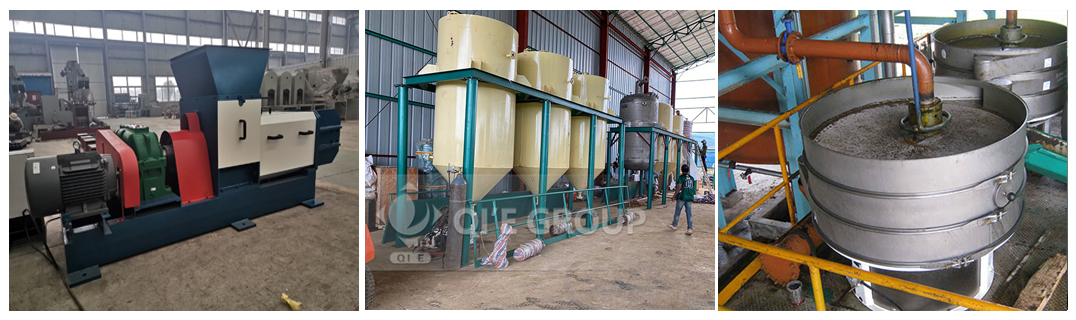
The manufacturing process of high quality palm oil will require the implementation of all the latest equipment in the market which includes: Palm Oil Sterilization Machine, Thresher Drum, Screw Press Palm Oil Mill, Palm Oil Refinery and more.
Included in the start-up budget, along with the new fixtures and new equipment, employees remunerations will need to be considered which could be paid weekly or monthly. The budget plan must include this, for a definite period of time, as profits will not start making an impact until the operation is up and running successfully. That said the period between startup, and the company actually making any profits, should not be too long with the demand for the product on an upward trend.
In today’s environmentally world detailed studies will need to be undertaken to make sure that the palm oil processing plant will not have any kinds of detrimental effects in the area the plant will be located. There are environmental advantages, with this kind of operation, which is described as being environmentally friendly with a number of recycling opportunities so far.
Palm oil milling process is quite a complicated procedure which includes a number of steps. This kind of fruit has a high quantity of acidic enzyme which means there has to be a 24-hour procedure to control this.
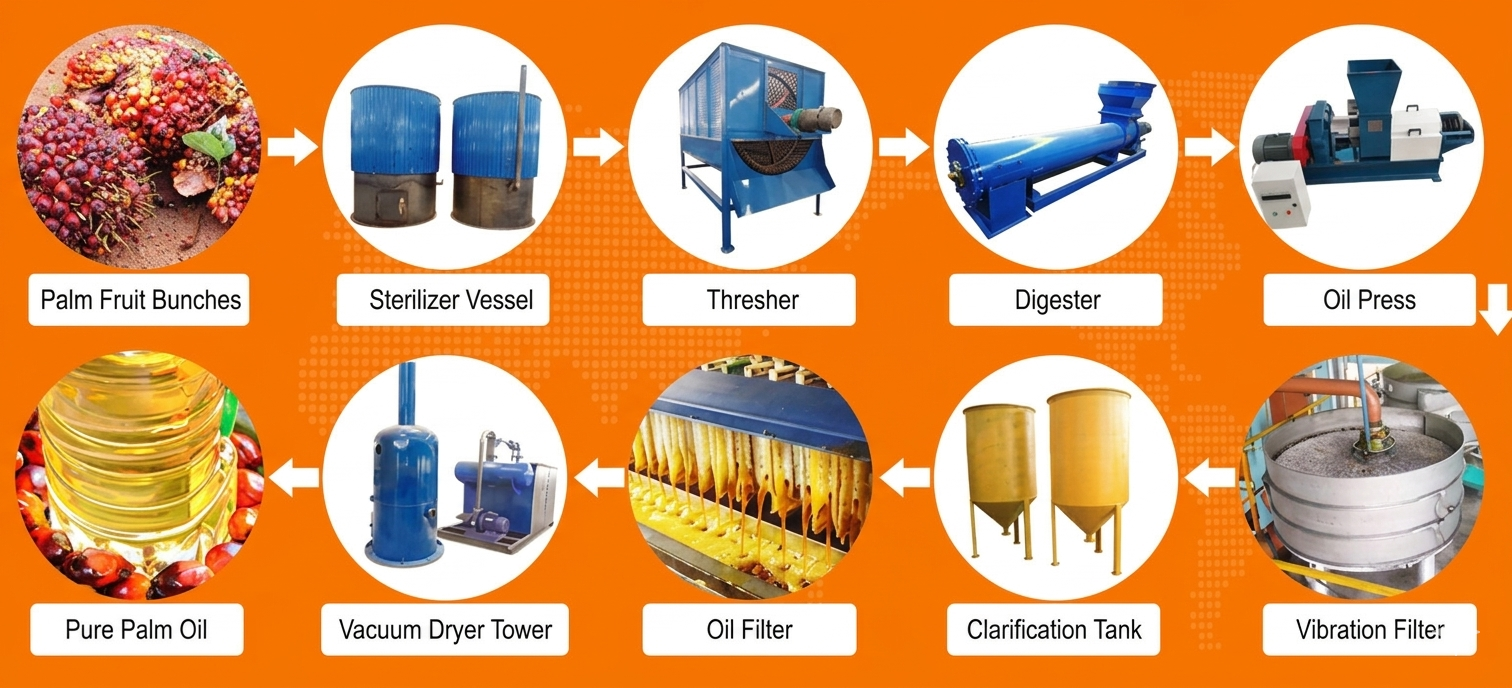
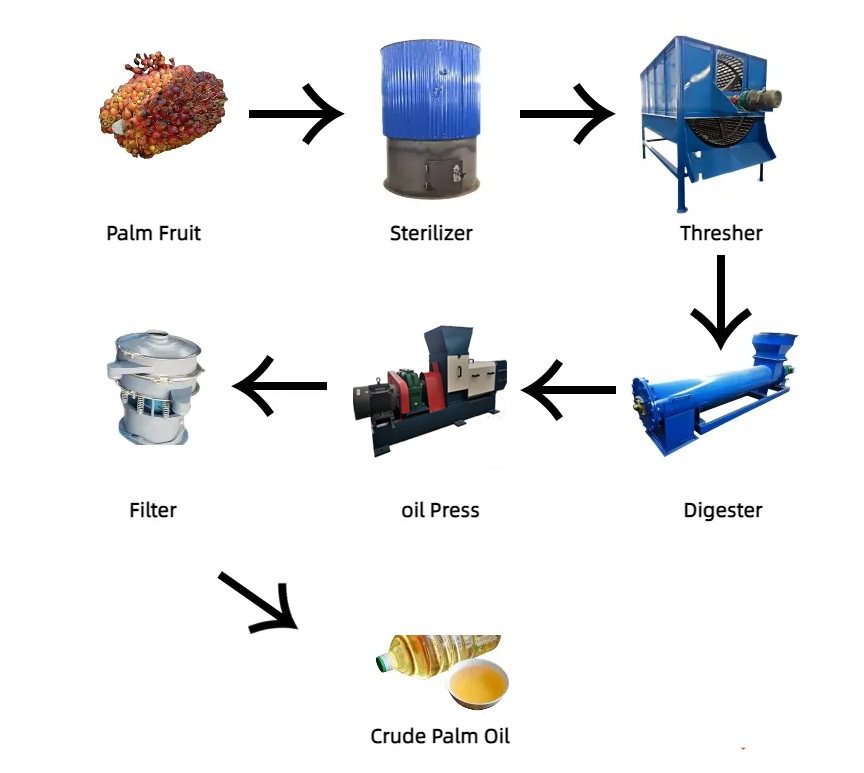
The process is a well-orchestrated sequence of steps, each building upon the last.
1. Reception and Sterilization
The process begins the moment fresh fruit bunches (FFB) arrive at the mill. The bunches are weighed and inspected for quality. The most critical step, sterilization, follows immediately. The FFB are loaded into cages and treated with high-pressure steam at around 140°C for 75 to 90 minutes. This process is vital for several reasons:
2. Threshing (Stripping)
After sterilization, the bunches are fed into a rotary drum thresher. As the drum rotates, the bunches are lifted and dropped, causing the individual fruits to be knocked off the main stem. The empty fruit bunches are then collected and can be recycled as fuel for the mill’s boilers or returned to the plantation as fertiliser.
3. Digestion
The loose, sterilized fruits are now conveyed to a digester. This is a steam-heated, cylindrical vessel with a central rotating shaft fitted with stirring arms. The mechanical action of the arms mashes the fruit into a uniform pulp, breaking open the oil-bearing cells in the mesocarp (the fruit’s flesh) to release the oil. The heat from the steam also helps to further condition the oil for extraction.
4. Oil Extraction (Pressing)
The digested fruit mash is then pressed to separate the oil. This is almost universally done using a twin screw press. The mash is fed into the press, where a large screw conveys it against a constriction point. This intense pressure squeezes out the crude oil, which is collected as a mixture of oil, water, and solid debris. The leftover solid material, a “press cake” of fibre and nuts, is conveyed away for further processing to recover the kernels.
5. Clarification and Purification
The crude oil mixture from the press is far from pure. It is pumped into a clarification tank and maintained at about 90°C to help the oil separate from the water and heavier solids. The oil rises to the top and is skimmed off, while the denser impurities settle at the bottom. The oil is then passed through a high-speed centrifuge for final purification and a vacuum dryer to reduce its moisture content to below 0.1% for safe storage.
When setting up a palm oil processing mill in Ghana, your chosen processing capacity dictates your entire business model—including your capital expenditure (CAPEX), land footprint, target supply chain, and regulatory complexity.
Small to Medium-Scale Capacity (2 to 5 Tons of FFB / Hour)
This is the most popular entry point for commercial investors looking to tap into Ghana’s 200,000 metric ton national supply deficit.
Medium to Large-Scale Capacity (6 to 15 Tons of FFB / Hour)
At this capacity, the mill shifts from a localized facility to a high-volume, centralized agro-industrial factory.
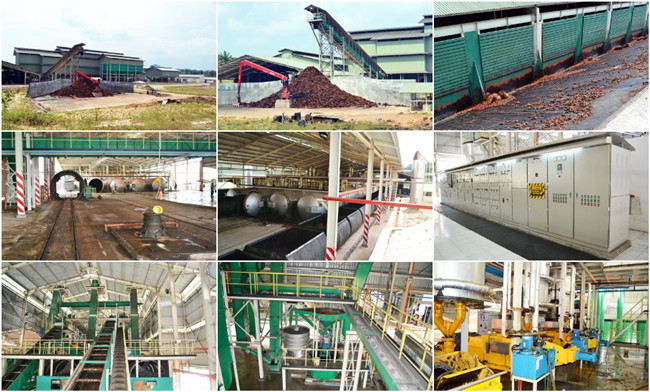
Large-Scale / Industrial Capacity (20+ Tons of FFB / Hour)
This represents world-class, fully automated industrial milling, matching the standard operations seen in Malaysia and Indonesia.
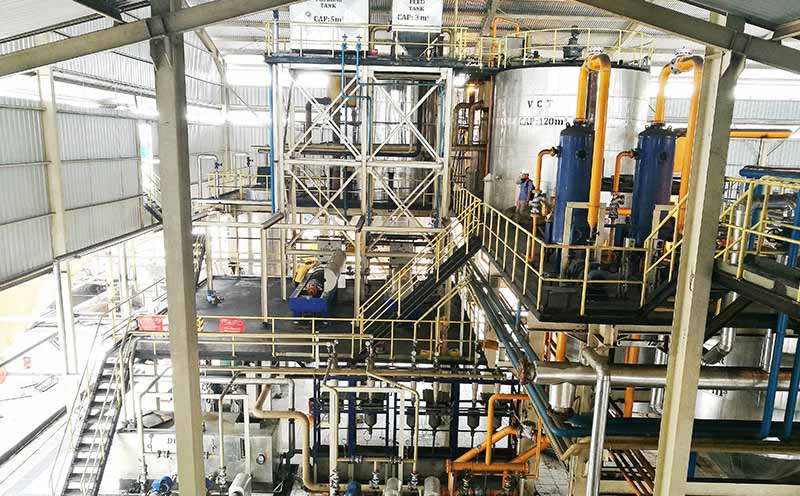
QIE Machinery, the top-rated palm oil mill plant supplier, has gained rich experience to provide the best palm oil processing machines in Ghana. We boasts professional design and development team to customize the advanced palm oil processing machines and techniques for our Ghana customers. Believe it or not, there, you will enjoy the first-class service and premium quality machines. You are welcomed to contact us for more detailed information about the palm oil processing mill and palm oil processing machines. We will offer you the specific list of palm oil processing machines and quote the latest cost of palm oil processing mill.


Palm Oil Production Line
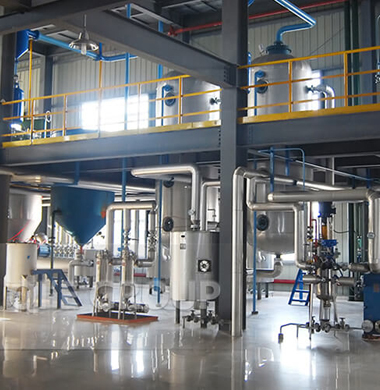
Palm Oil Refinery Plant
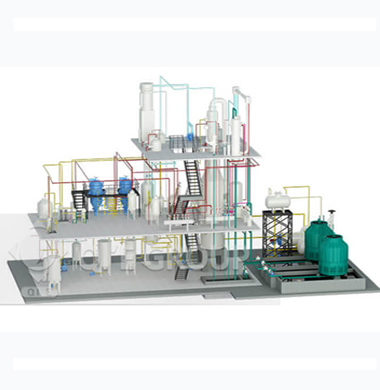
Palm Oil Fractionation Plant

Small Scale Palm Oil Processing Plant
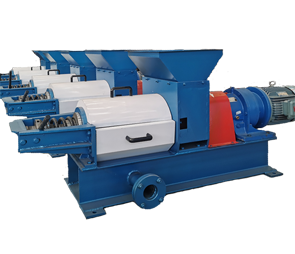
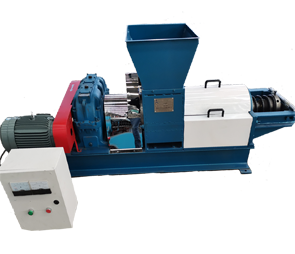
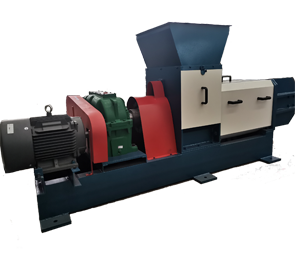
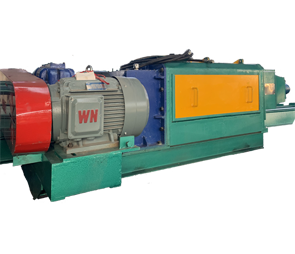
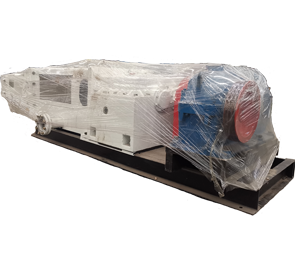
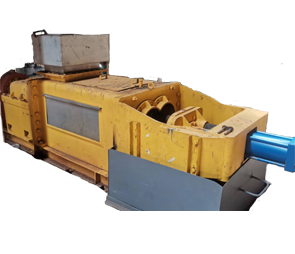
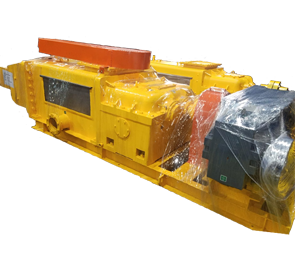
QIE Machinery offers a complete range of core equipment and related auxiliary equipment for palm oil solutions.
Whether you contact us by phone, email, or leave a message online, we will provide you with comprehensive and high-quality services.
Phone: 0086-13949113983
WhatsApp:
Email: qiea@oilpresses.org
Address: No.352 Lianhua Street, Hightech Industrial Development Zone, , Zhengzhou City,Henan Province, China
